


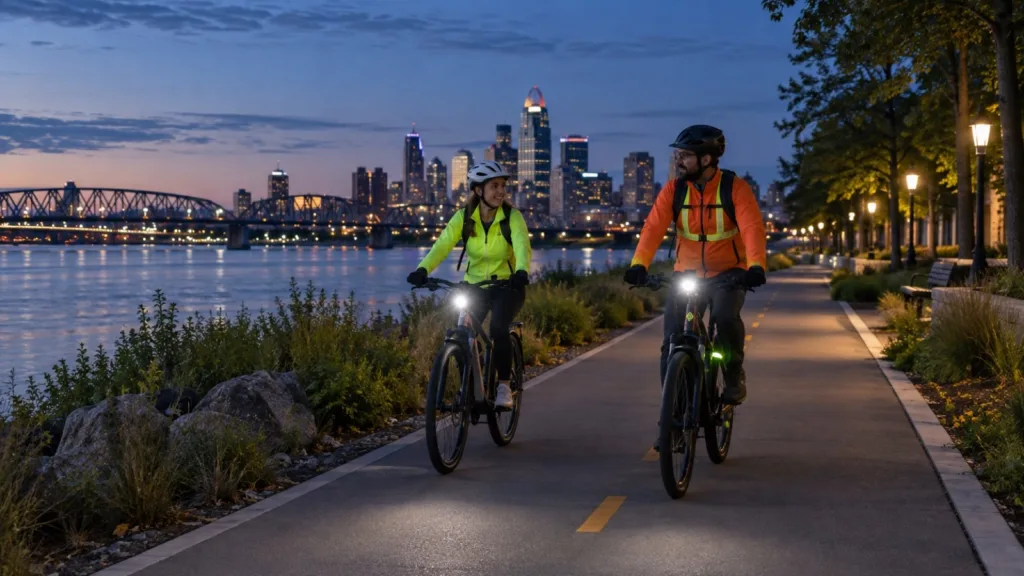
Riding an e-bike after dark changes how early you can see a hazard and how easily other road users can see you. Plan for both. Use lights and reflective items, choose a route with good visibility, and slow down enough to stop within the area you can see.
This is general safety guidance, not a summary of every state or local lighting law. Check the rules where you ride and follow the instructions for your bike’s lighting system.
Make yourself visible from the front and rear
The National Highway Traffic Safety Administration recommends a white front light and a red rear light or reflector for riding at night or when visibility is poor, along with reflective gear. See the NHTSA bicycle safety guidance for its broader checklist.
Before leaving, confirm that lights are charged, attached securely and not blocked by bags or clothing. Reflective details on clothing or a backpack can help other road users notice movement, but reflective material does not replace lights where lights are required.
Do not assume that an integrated light is bright enough for every route or legally sufficient in every location. Check the product documentation, local rules and conditions where you ride. Avoid aiming a bright beam into other people’s eyes.
Choose a route that gives you time to react
For an unfamiliar ride, prefer well-lit, lower-traffic streets or designated paths where e-bikes are allowed. Avoid routes with poor sightlines, fast traffic or surface hazards you cannot see in time. A route that is comfortable during the day may need a different choice at night.
Reduce speed around intersections, driveways and shared paths. Leave more room to stop, signal predictably and look for pedestrians who may be difficult to see. If glare, rain or fog makes the route hard to read, stop somewhere safe and reconsider the trip.
Check the bicycle before setting out
Squeeze both brakes, check tire condition and make sure the wheels turn freely. Confirm that the display and controls are easy to use without taking your attention away from the path. Keep a phone accessible for emergencies, but do not handle it while riding.
Carry bags so they do not cover lights, reflectors or your view. If you have recently added an accessory, check the full bicycle from the front and rear to confirm that visibility is still clear.
Keep a backup plan
Tell someone your route if you are riding alone in a remote area. Check the weather and battery before leaving, and carry a charged phone. If a light fails or visibility deteriorates, stop in a safe location and use a route or transport option that does not require continuing in unsafe conditions.
The useful night-riding routine is simple: make the bike visible, make the route predictable, and ride at a speed that matches what you can see. Recheck local lighting requirements before riding in a new city or state.